



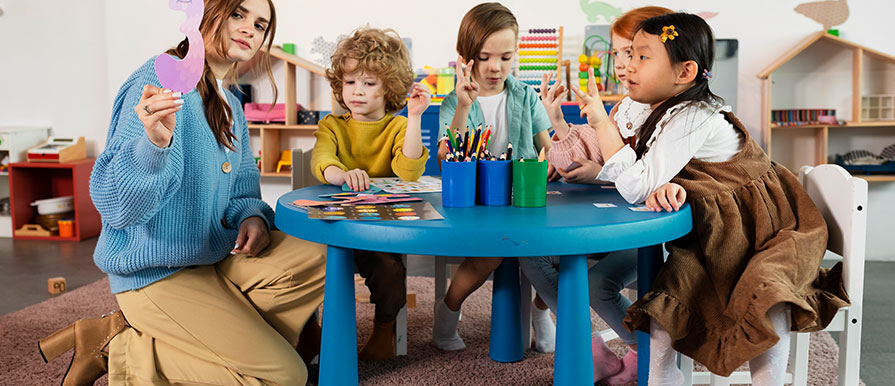
Play is how young children explore, test ideas, and understand daily life. When your child stacks cups, pretends to cook, or chases bubbles, their body and brain learn together. You don’t need fancy toys; you need time, space, and a caring adult who joins in for short bursts. During play, children practice skills they’ll later use for reading, writing, math, and friendships. You’ll often see growth in small moments:
Trying again after a fall
Asking “why” and “what if.”
Sharing a toy and waiting
When play feels warm and safe, children take chances, use new words, and trust their own ideas. Even five focused minutes with you can steady feelings and guide choices for hours.
Brain Builds Fast
From birth to age five, the brain grows very quickly. Many child development sources note that early on, the brain can form about 1 million new neural connections each second. Play helps strengthen the pathways your child uses most, like attention, movement, and language. It also supports myelination, which is like adding insulation around nerve paths so messages travel faster. You can notice this “wiring” at work when your child:
Repeat a game to get steadier.
Changes a rule and watches the result
Links actions to outcomes, like cause and effect
With kind support, the brain stores these patterns, making later skills easier to build. That’s why short daily play often beats long play sessions.
Language Through Play
Play gives children a reason to talk, listen, and respond. When you join their pretend store or animal game, you create a back-and-forth conversation that builds vocabulary and grammar. Short pauses matter because your child needs time to process and answer. This kind of talk supports phonemic awareness, too, which is hearing and playing with sounds in words. Try adding language to play like this:
Name what your child is doing (“You’re pouring.”)
Add one new word (“That’s a heavy scoop.”)
Invite a choice (“Do we need cups or plates?”)
Keep the play going so words stay tied to real actions. That link helps children remember and use new language later in everyday talk.
Math In Motion
Early math is not worksheets; it’s pattern, size, and number in motion. When children sort buttons, line up cars, or build towers, they practice comparing, counting, and measuring without noticing. These skills are part of number sense, which supports later math learning. Blocks also teach spatial skills, like shape and fit, which later support geometry ideas. You can weave math into daily play by:
Counting steps as you climb or hop
Spotting patterns like red-blue-red-blue
Using “more,” “less,” and “same” during snack play
Between ages 3 and 5, many children move from rote counting to understanding that the last number said means “how many.” This shift supports adding and taking away later.
Move To Learn
Active play strengthens the heart, lungs, and bones, and it also supports brain systems that control balance and focus. Running, jumping, climbing, and dancing feed the vestibular system (balance) and proprioception (body awareness). That body input can help children sit, write, and pay attention later. The World Health Organization suggests children ages 3–4 get at least 180 minutes of physical activity a day, including 60 minutes of energetic play. Try simple options like:
Obstacle courses with pillows and tape lines
Follow-the-leader with fast and slow moves
Ball play: roll, toss, catch, kick
Short bursts throughout the day count. Movement breaks can also lower restlessness and support better sleep. Even indoor play works.
Hands Get Ready
Fine motor play builds the hand strength and control children need for feeding themselves, buttoning, cutting, and early writing. Squeezing, pinching, and twisting help develop the small finger muscles and the pincer grasp used to hold crayons and utensils. These skills grow through fun, not pressure, and they need practice over time. Strong hand skills also support self-help tasks, which build confidence and independence every day. Mix in activities like:
Play-dough: roll, pinch, and poke
Tongs or tweezers to move pom-poms
Stickers and tearing paper for collages
Keep it relaxed; when children feel safe, they use their hands longer. Longer practice builds endurance for school tasks like drawing and learning letter shapes.
Social Skills Grow
Play is a social lab where children learn to read faces, take turns, solve small conflicts, and recover when things don’t go their way. In the preschool years, play often shifts from side-by-side play to more cooperative play, where kids share goals and roles. This change often becomes steadier around age four, though every child is different. You can support social growth by:
Modeling simple phrases (“Can I have a turn?”)
Coaching calm breaths after frustration
Noticing kind choices (“You helped your friend”)
When play feels guided but not controlled, children learn empathy and patience. They also learn that problems can be fixed with words, not grabbing. This often makes group time smoother.
Self-Control Through Games
Many games teach self-control because children have to stop, start, remember rules, and wait. These are parts of executive function: working memory, flexible thinking, and inhibitory control. These skills rely on the prefrontal cortex, which grows quickly in early childhood years, too. “Red light, green light” and “Simon Says” work well because your child must listen closely and manage impulses. During rule-based play, you’ll see practice in:
Holding a rule in mind while moving
Switching gears when the rule changes
Handling a small loss and trying again
Start with short rounds and simple rules, then build up. When children succeed at small steps, they’re more willing to try harder ones without big tears.
Solve Small Problems
Children learn problem-solving by meeting small challenges and figuring out what to do next. Play invites healthy risk, like climbing a little higher, pouring without spilling, or building a bridge that keeps falling. These moments teach planning, testing, and resilience. They also practice simple engineering, like making a base wider so a tower stands firmly. Keep playing safely while still letting effort happen by:
Staying close, but not stepping in too soon
Asking “what could you try next?”
Offering tools, like a stool or tape, not answers
When children handle manageable risks, they learn to judge space, speed, and balance. Over time, that body judgment can reduce bumps and build confidence in new places.
Support Play Daily
You can support play-based learning with a few habits at home. Choose open-ended materials, meaning they can be used in many ways, like blocks, scarves, and empty boxes. Protect play time by keeping screens limited and choosing simple routines. The American Academy of Pediatrics suggests children ages 2–5 have about one hour a day of high-quality screen time, with an adult nearby when possible. Helpful steps include:
Set up a small “yes space” for safe exploring
Rotate toys instead of buying more
Follow your child’s lead for 10 focused minutes
Watch first, then guide gently with one question or one new idea. This keeps your child engaged and builds skills naturally.
Keep Play Simple
Play-based learning works because it matches how young children grow: through movement, talk, trial, and connection. You don’t need to plan every minute. Offer a few materials, a safe space, and your attention, and your child will do the rest. Look for small signs of progress, like longer focus, kinder words, or smoother movement. A simple rhythm helps:
A bit of active play
A bit of pretend or building
A quiet reset with books or drawing
When play is part of daily life, learning happens all day, not only during “lesson time.” For a caring setting where play and early learning go hand in hand, reach out to Little Hearts Family Child Care LLC.